In the rarified world of palatial interior design, a unique and powerful synergy exists between two seemingly disparate traditions: the grand legacy of classic Italian furniture and the revered cultural practice of Saudi hospitality. This relationship finds its most profound expression in the Majlis, the quintessential space for reception and dialogue in the Arabian Peninsula. The act of furnishing these sacred spaces is not merely a matter of decoration; it is a declaration of status, a gesture of profound respect, and an essential component in the art of welcome. At the vanguard of this cultural synthesis stands Modenese Furniture, a company whose history, stretching back to 1818, is a testament to the enduring power of Italian craftsmanship. With a mastery of classic styles forged over two centuries, Modenese represents the pinnacle of a tradition perfectly suited to meet the exacting demands of the world’s most exclusive interiors, particularly the royal Majlis of Saudi Arabia.1
This report will explore the deep historical and cultural currents that underpin this remarkable convergence. It will begin by establishing the foundational aesthetic vocabulary of European luxury, tracing the evolution of the Baroque, Rococo, and Neoclassical styles. It will then delve into the rich history of Italian furniture making, revealing the ecosystem of regional craftsmanship and artisanal skill that has secured its global preeminence. Following this, the report will offer a nuanced analysis of the Majlis, examining its profound cultural significance as a UNESCO-recognized cornerstone of Saudi social life. Finally, it will demonstrate how the core tenets of classic Italian design—its grandeur, comfort, and unparalleled craftsmanship—align seamlessly with the functional and symbolic requirements of the Majlis. Through a detailed case study of Modenese Furniture and its extensive work in the Kingdom, this report will argue that the union of these two traditions creates spaces of unparalleled majesty, where the timeless art of hospitality is elevated to its highest form.
Foundations of Timeless Luxury
Chapter 1: The Grand European Design Lexicon: Baroque, Rococo, and Neoclassical
To comprehend the aesthetic language of modern palaces and grand residences, one must first understand the historical styles that form their grammar. The “classic” in classic luxury is not a monolithic concept but a dynamic evolution of three distinct yet interconnected European design periods: Baroque, Rococo, and Neoclassical. These are not merely historical artifacts but living languages of design, each communicating specific values of power, intimacy, and order. Their enduring appeal lies in their ability to imbue a space with a sense of history, grandeur, and profound cultural weight.
1.1 The Age of Grandeur: The Baroque (c. 1600-1750)
Originating in 17th-century Italy, the Baroque style was a powerful tool of the Counter-Reformation, employed by the Catholic Church to inspire awe, convey power, and create a sense of divine majesty on Earth.3 This philosophy quickly spread to the royal courts of Europe, where absolute monarchs adopted its principles to project their own wealth and authority. The style is defined by its core tenets of grandeur, opulence, and drama, executed on a massive, theatrical scale.3
Baroque interiors are characterized by an abundance of luxurious and heavy materials. Rich textiles such as velvet, silk, and brocade were used extensively, complemented by vast expanses of marble and an overwhelming application of gold gilding to create an atmosphere of immense wealth.3 The decorative motifs were complex and dynamic, featuring swirling forms, acanthus leaves, scrolls, and cherubs, all rendered in deep, bold colors like reds, purples, and greens to create striking contrasts.3
Furniture from this period was designed to be as imposing as the architecture it inhabited. Pieces were large in scale, heavily ornamented with intricate carvings, and often anchored to the walls, with undecorated backs.3 Grand armoires, massive dining tables, and sumptuous console tables with caryatid legs were common, crafted from dark woods and adorned with gilded frames and rich fabrics.3 The ultimate expression of this style can be found in the Palace of Versailles in France, particularly its Hall of Mirrors, which remains the global benchmark for Baroque opulence.3
1.2 The Flourish of Intimacy: The Rococo (c. 1730-1770)
By the early 18th century, a reaction against the heavy formality and overwhelming scale of the Baroque began to emerge in France. The Rococo style represented a shift towards a more playful, light-hearted, and intimate aesthetic, better suited to the salons and private residences of the aristocracy than the grand halls of state.9 While it grew out of the Baroque, it replaced its predecessor’s imposing grandeur with a focus on comfort, elegance, and personal pleasure.
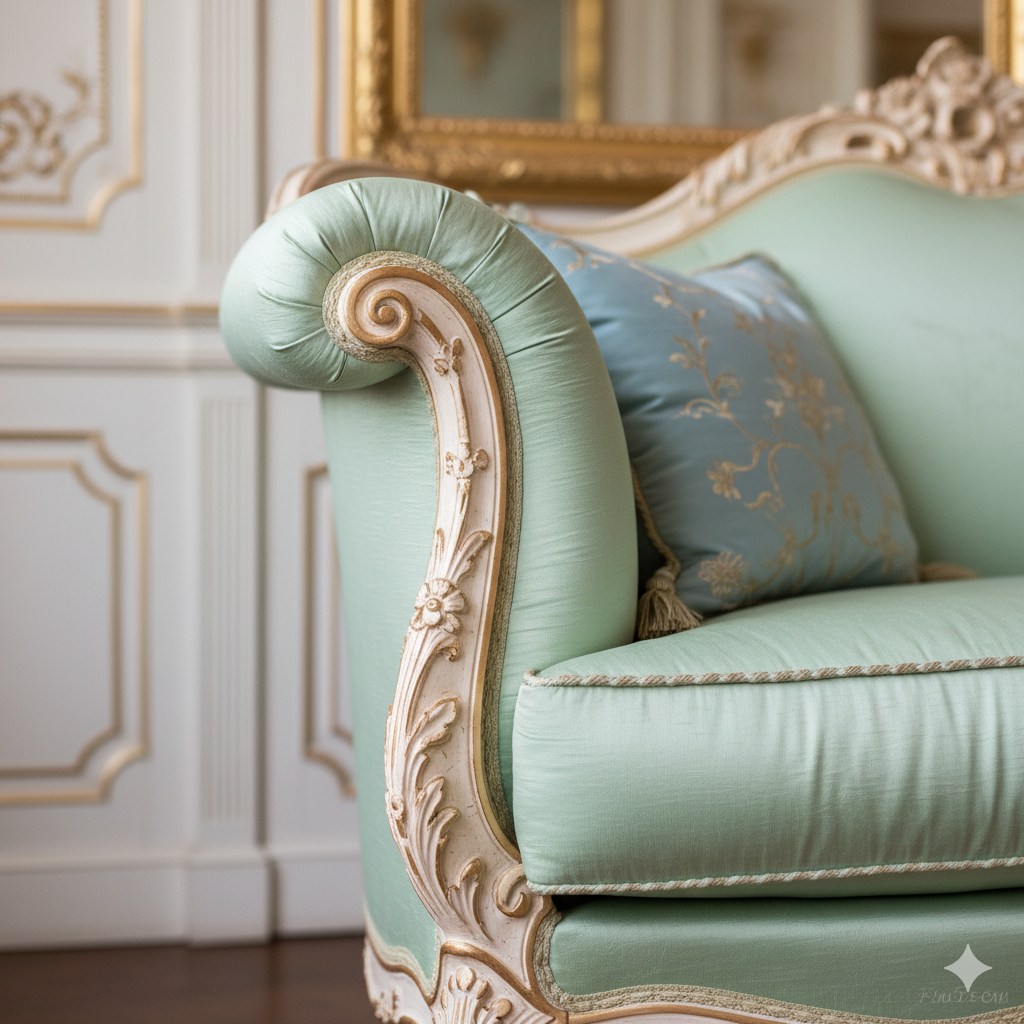
The core tenets of Rococo are asymmetry, an abundance of sensuous curves, and a deep inspiration drawn from nature.11 The style is named for the French word rocaille, meaning rock or shell work, which, along with stylized flowers and vines, became its signature motifs.13 The heavy, dramatic forms of the Baroque gave way to graceful S-shaped and C-shaped scrolls, creating a sense of fluid, organic movement.13 The color palette also lightened considerably, favoring soft pastels, creams, and the continued use of gold and white accents.10 Reflecting the expansion of global trade, Rococo interiors often incorporated exotic chinoiserie motifs, such as Japanese lacquerwork and Chinese landscapes.8
Rococo furniture was designed with human comfort and social interaction in mind. The distinctive S-curved cabriole leg became a hallmark of tables and chairs, lending them an air of lightness and grace.14 Pieces were still ornately carved and often gilded, but the overall effect was more delicate and refined. The goal of a Rococo interior was to create a unified, theatrical ensemble—a gesamtkunstwerk—where the furniture, carved wooden paneling (boiserie), paintings, and porcelain blended seamlessly to create a harmonious and enchanting atmosphere.14
1.3 The Return to Order: Neoclassicism (c. 1760-1830)
As the 18th century progressed, the perceived frivolity and excess of the Rococo style prompted another aesthetic shift. The archaeological discoveries of Pompeii and Herculaneum sparked a widespread fascination with the classical worlds of ancient Greece and Rome, giving rise to the Neoclassical movement.16 This style was a deliberate return to the principles of order, reason, and restrained elegance, championing the classical ideals of symmetry, straight lines, and geometric precision 16
Neoclassical interiors rejected the swirling asymmetry of Rococo in favor of a balanced and harmonious arrangement. The color palette became more muted and sophisticated, dominated by whites, creams, soft pastels, and subdued grays.16 Decoration was inspired directly by antiquity, with classical architectural motifs such as columns, pilasters, pediments, and Greek key patterns frequently incorporated into wall treatments and furniture design.16 High-quality materials remained paramount, with a preference for fine woods like mahogany and walnut, complemented by marble surfaces and tasteful gilded accents that added a touch of opulence without being ostentatious 17
Neoclassical furniture reflects this emphasis on structure and simplicity. Pieces feature clean lines, exposed wood frames, straight or elegantly tapered legs, and symmetrical forms.19 While often embellished with ornate carvings of classical motifs like acanthus leaves or laurel wreaths, the overall effect was one of grandeur and sophistication, more understated and intellectually rigorous than the styles that preceded it.17
The evolution from the public, state-projecting power of Baroque palaces to the intimate, aristocratic salons of Rococo, and finally to the intellectually-driven order of Neoclassicism, is more than a simple timeline of taste. It is a direct reflection of the profound shifts in European social and political structures. The Baroque was the aesthetic of absolute monarchy and the church, a top-down projection of divine and temporal power designed to awe the masses.3 The subsequent rise of Rococo in the private hôtels particuliers of Paris signaled a diffusion of power to a highly influential aristocracy, whose status was performed and negotiated in sophisticated social gatherings.10 Luxury, in this context, became more intimate and exclusive. Finally, the emergence of Neoclassicism, with its emphasis on the democratic and republican values of ancient Greece and Rome, coincided with the Age of Enlightenment and the rise of a wealthy bourgeois class.17 This new elite sought to legitimize its status not through inherited grace but through a style associated with reason, timeless principles, and intellectual merit. This historical progression provides a crucial framework for understanding why these classic styles continue to resonate with modern elites, who often wish to project a similar blend of power, sophistication, and enduring legacy.
| Style | Core Philosophy | Key Motifs & Colors | Defining Furniture Characteristics |
| Baroque | Grandeur, drama, opulence, power, theatricality | Acanthus leaves, scrolls, cherubs, swags. Deep reds, purples, greens, extensive gold. | Large scale, imposing, heavily ornamented, often anchored to walls. Elaborate carvings, rich fabrics, massive forms. |
| Rococo | Intimacy, elegance, playfulness, comfort, nature-inspired | Shells (rocaille), flowers, vines, C & S scrolls, chinoiserie. Pastel shades, white, gold. | Asymmetrical balance, delicate ornamentation, and focus on comfort. The cabriole leg is a key feature. Lighter and more graceful forms. |
| Neoclassical | Order, reason, symmetry, restraint, classical antiquity | Columns, pediments, laurel wreaths, and Greek key patterns. Muted palette of whites, creams, soft grays, pastels. | Symmetrical, clean lines, geometric shapes. Tapered legs, exposed wood frames, refined and understated ornamentation. |
Chapter 2: The Italian Art of Furniture: A Legacy of Unrivaled Craftsmanship
While the grand design styles of Europe set the aesthetic stage, it was the artisans of Italy who perfected the art of creating the physical objects of luxury. Italy’s preeminence in high-end furniture is not a recent phenomenon but a legacy built over millennia, derived from a unique convergence of deep historical roots, a specialized ecosystem of regional craftsmanship, and an unwavering devotion to the world’s most noble materials. To own a piece of classic Italian furniture is to own a piece of this history, a tangible link to a tradition of unrivaled artistry.
2.1 From Renaissance to Republic: A Timeline of Italian Dominance
The story of Italian furniture begins in antiquity, with remnants of ornate wooden and bronze pieces adorned with ivory and tortoiseshell unearthed from the ruins of Pompeii, demonstrating a sophisticated design culture flourishing over two thousand years ago.21 Following the more austere Dark Ages, the 15th century and the dawn of the Renaissance marked the true golden age of Italian design.21 Fueled by the patronage of powerful families like the Medicis, who encouraged creative excellence, Italian craftsmen rediscovered classical Greco-Roman forms and elevated furniture making to an art form.9 Renaissance pieces were characterized by symmetry, intricate details, and a harmonious blend of form and function, often with embellishments that seemed more important than the furniture’s practical use 21
During the 16th and 17th centuries, Italian design absorbed influences from the Near and Far East while simultaneously giving birth to the Baroque style. This period saw Italian artisans take ornamentation to new, lavish heights, with extensive use of gold and silver leaf, intricate woodcarving, and stunning marble inlays.21 While the rest of Europe embraced ever more decadent styles in the 18th century, Italian furniture makers briefly pivoted towards simpler, geometric shapes before a 19th-century revival of Gothic and Rococo forms.21 This dynamic history illustrates Italy’s central and often leading role in defining the trajectory of European luxury design.
2.2 The Geography of Genius: Italy’s Manufacturing Districts
A distinctive feature of Italian industry, and a key to its enduring success in the furniture sector, is its organization into specialized “industrial districts”. .26 These are geographically concentrated areas where networks of often family-run businesses collaborate and compete, fostering an environment of unparalleled expertise and innovation. This model has allowed for the preservation of artisanal skills while enabling production on a global scale. The main furniture-producing regions are Lombardy, Veneto, Friuli-Venezia Giulia, and Tuscany 26
- Lombardy (Brianza): This region, particularly the area around Monza and Brianza, is the undisputed leader in Italian furniture, ranking first in turnover and exports. It specializes in high-end designer furniture, encompassing wooden pieces, upholstered items, and metal accessories.26 Its historical development was significantly catalyzed by the need to furnish the Villa Reale in Monza, which brought together the region’s finest carpenters, glaziers, and decorators.27
- Veneto: Known as the “Classic Furniture District,” the southern Veneto plain is a hub for traditional furniture construction. Its artisans are masters of classic styles, focusing on polishing, restoration, and the assembly of period-perfect pieces.26
- Friuli-Venezia Giulia (Manzano): This region is famously known as the “Chair District.” The area around Manzano has a highly specialized production chain dedicated to chairs and tables.26
- Tuscany: This region is celebrated for its more rustic style, characterized by robust designs crafted from local woods like walnut, chestnut, and cypress, resonating with the area’s serene landscapes.22
2.3 The Sanctity of Materials and Methods
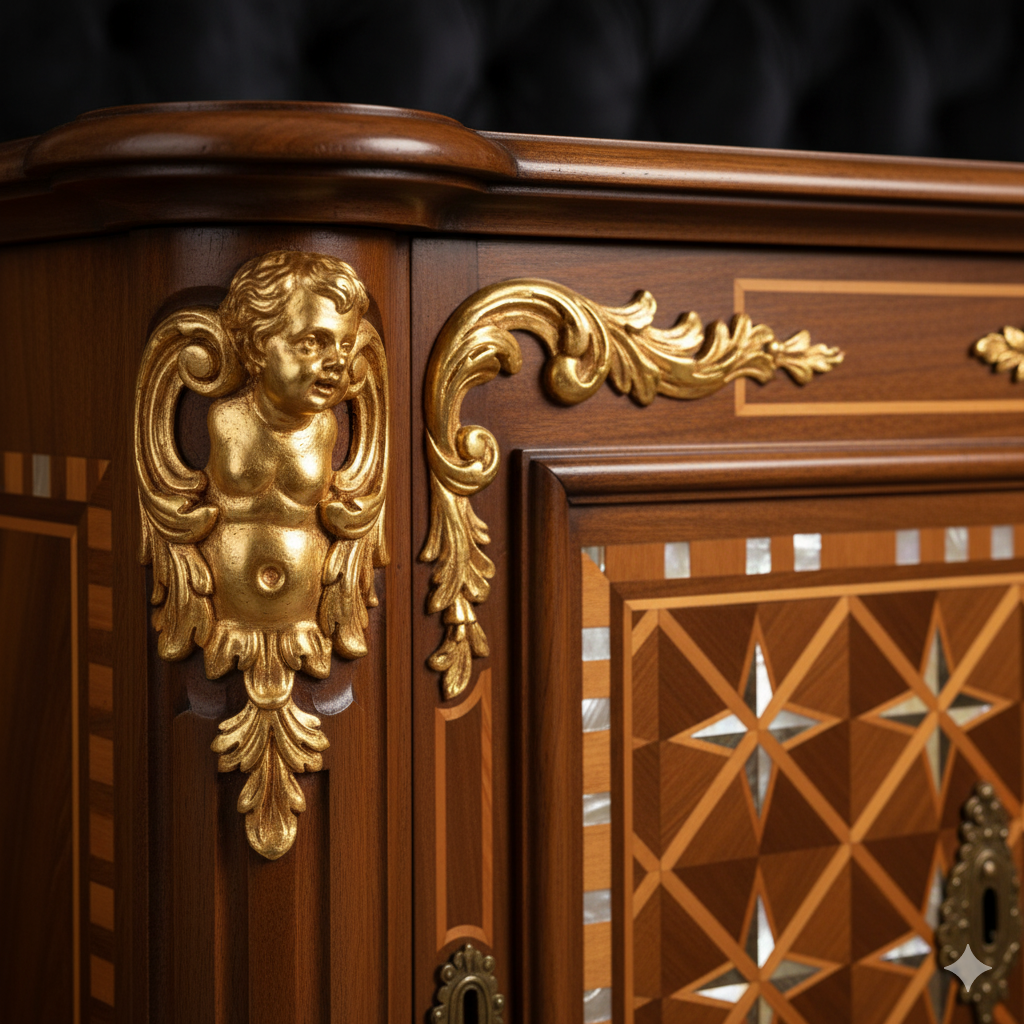
At the heart of classic Italian furniture is a profound reverence for materials and the traditional methods used to shape them. The luxury is tangible, expressed through the selection of the finest natural resources: high-quality solid woods, prized for their grain and durability; lustrous marble, quarried from Italy’s famous mountains; the finest full-grain leathers; and sumptuous fabrics like silk and velvet.25 These are elevated by precious finishing touches, most notably the application of gold leaf, which imbues a piece with an unmistakable aura of opulence.29
This commitment to materials is matched by a dedication to time-honored craftsmanship. Traditional techniques, passed down through generations of artisans, are central to the production process. These include the meticulous arts of hand-carving, which transform wood into intricate sculptural forms; precision joinery, which ensures structural integrity; marquetry and inlay, the delicate process of creating pictures and patterns with veneers of wood, shell, or ivory; and the painstaking application of gilding.2 It is this human touch, this investment of skill and time, that distinguishes authentic Italian furniture from mass-produced goods and elevates each piece to the status of a functional work of art.25
The enduring global dominance of the Italian furniture industry is not merely a consequence of a celebrated design history. It is the product of a resilient and highly specialized ecosystem of geographically concentrated, family-run enterprises. This “district” model fosters a unique culture of intense competition and deep collaboration, which simultaneously preserves multi-generational artisanal skills while driving innovation and allowing for industrial scale.26 The clustering of all necessary expertise—from wood carving and gilding to upholstery and metalwork—within a single region creates an environment of unparalleled quality control.27 This structure is also remarkably agile, capable of producing both “tailor-made” and “on design” pieces that cater directly to the bespoke demands of the global luxury market.26 Consequently, when a client commissions a piece of classic Italian furniture, they are not simply engaging with a single manufacturer. They are accessing an entire regional ecosystem of accumulated knowledge and specialized craft. This is the foundational strength of the “Made in Italy” promise, a crucial component of its unmatched quality and prestige.
| Region/District | Key Cities | Primary Specialization | Historical Significance |
| Lombardy / Brianza | Monza, Brianza, Cantù, Meda, Lissone | High-end designer wooden & upholstered furniture, metal accessories | Italy’s top region for turnover & exports. Historically furnished the Villa Reale in Monza. Known for “tailor-made” and “on design” production. |
| Veneto | Verona, Padova, Rovigo | Classic & traditional furniture construction, polishing, restoration | Known as the “Classic Furniture District,” with a majority of companies working exclusively on classic furniture styles. |
| Friuli-Venezia Giulia | Manzano, San Giovanni al Natisone | Chairs and tables | Famously known as the “Chair Triangle” or “Chair District,” a global center for seating production. |
| Tuscany | Quarrata, Poggibonsi | Upholstered furniture, rustic styles using local woods | Known for its artistic legacy and use of local materials like chestnut and cypress, creating a distinct rustic charm. |
The Sacred Space of Hospitality
Chapter 3: The Majlis: More Than a Room, A Cultural Cornerstone
To understand the design requirements of a royal Saudi Majlis, one must first appreciate that it is not merely a reception room. It is a vital, living institution at the very heart of Saudi and Arabian Peninsula culture, a sacred space whose profound social and political functions dictate its physical form. Its importance is such that the Arab proverb states, “Al Majalis Madaris”—”the Majlis are schools”.30
3.1 The Meaning of Majlis: A UNESCO-Recognized Heritage
The term Majlis derives from the Arabic verb jalasa, “to sit,” and literally means a “place of sitting” or a “council”.30 It is a space for gathering, dialogue, and community. In recognition of its crucial role in preserving and transmitting cultural values, the Majlis was inscribed in 2015 on UNESCO’s Representative List of the Intangible Cultural Heritage of Humanity. This was a joint submission by Saudi Arabia, the United Arab Emirates, Oman, and Qatar, a testament to its shared importance across the region.30
3.2 The Social Functions of a Sacred Space
The Majlis is a multi-faceted institution that serves as the beating heart of the community, fulfilling several critical roles simultaneously.
- Hospitality Hub: Its most visible function is as a space for receiving and entertaining guests. Hospitality is a cherished virtue in Arab culture, and hosts take immense pride in ensuring the comfort and honor of their visitors.32 The Majlis is the primary stage upon which this hospitality is performed.
- Community Center: It is the central gathering place for the community to discuss local events, exchange news, resolve problems, pay condolences after a death, and celebrate weddings.33 It is a space open to all members of the community, reinforcing social bonds.33
- School of Culture: The Majlis is the primary vehicle for the transfer of oral heritage. It is where elders pass down folk stories, folk songs, and ‘Nabati’ poetry to younger generations.33 By observing their elders in the Majlis, young people learn the manners and ethics of their community, the art of dialogue and respectful listening, and the history of their tribe and family.30
- Center of Governance: From ancient Bedouin tradition to the modern Saudi state, the Majlis has always been a forum for governance. Tribal elders, religious sheiks, and government leaders, from provincial governors up to the King himself, hold regular Majlis to meet with their communities, hear grievances, adjudicate disputes, and clarify rights and responsibilities 31
3.3 The Rituals of Welcome
The experience of being a guest in a Majlis is structured by time-honored rituals that symbolize generosity and welcome. Central to this is the preparation and serving of Arabic coffee (gahwa) and dates.34 A stove or fire for preparing these hot beverages is a traditional and essential feature of the space.33 The unhurried pace of these rituals creates a calm atmosphere that encourages conversation and connection, reflecting a cultural value placed on attentiveness and presence.31
The Majlis, therefore, functions as a physical manifestation of a society’s social contract. Its open and welcoming nature, combined with its central role in governance, justice, cultural transmission, and social cohesion, makes it the primary space where the bonds of community are forged, tested, and reinforced. The act of furnishing a Majlis is thus far more than simple interior decoration; it is a strategic investment in the social infrastructure of the family, the tribe, and the nation. The quality, luxury, and comfort of the furnishings are a direct and powerful reflection of the host’s generosity, their status, and the depth of their respect for their guests and the community at large—all core cultural values.34 The furniture itself becomes an active tool for performing the critical social functions of the Majlis, not merely a passive backdrop.
Chapter 4: Designing for Dialogue: The Evolving Aesthetic of the Modern Majlis
The interior design and architecture of the Majlis are not arbitrary; every aesthetic choice is purposeful, carefully calibrated to support the space’s vital social and cultural functions. The design must project prestige and honor the guest while simultaneously creating an atmosphere of comfort and welcome that is conducive to the open dialogue at the heart of the Majlis tradition.
4.1 Architectural Principles: Space for Gathering
The fundamental architectural requirement of a Majlis is space. It is typically a large, generously proportioned room designed to accommodate numerous guests comfortably and without crowding.33 To maintain the privacy of the family’s main living quarters, the Majlis often has its own separate entrance from the outside.33 Traditional architecture, particularly in the Najd region of Saudi Arabia, incorporates features like courtyards and pillared porticoes, with interior walls often decorated with fine incised plasterwork known as jis, featuring geometric and star-shaped designs.32
4.2 Interior Design: An Atmosphere of Welcome and Prestige
The interior of a Majlis is meticulously curated to create a specific atmosphere of dignified welcome.
- Layout: The traditional seating arrangement is communal and egalitarian, designed to foster conversation. It consists of cushions placed against the walls, either directly on the floor or upon a low, raised shelf that runs around the perimeter of the room.32 This layout ensures that all guests are seated in a circle or square, facing one another, which facilitates interaction and dialogue.
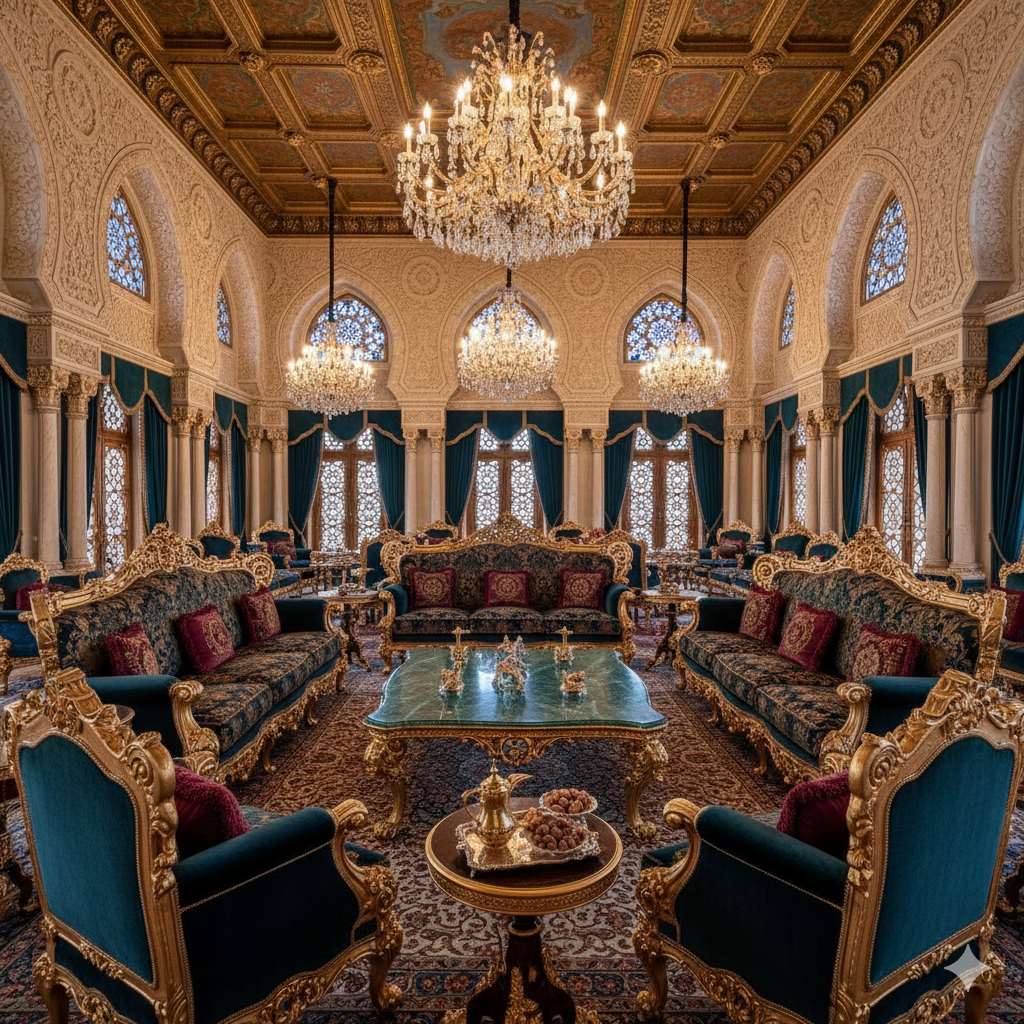
- Color & Materials: The palette of a luxury Majlis is often rich and sophisticated, blending classical and oriental styles. Deep, regal colors like purple and blue may be used as accents against a backdrop of warm neutrals and the gleam of gold.36 The materials are chosen to convey opulence and status, with a preference for marble flooring, fine woods, gilded accents on furniture and architectural details, and rich, luxurious textiles for seating and drapery.38
- Decorative Elements: Ornate decoration is a key feature, creating a sense of solemnity and celebration that speaks to the prosperity and impeccable taste of the homeowners.36 Important elements include elaborate stucco molding on the walls and ceilings, large and intricate mirrors that create dynamics and enhance the sense of space, plush, high-quality carpets that cover the floor, and an abundance of comfortable cushions.36
4.3 The Modern Majlis: Blending Tradition and Contemporaneity
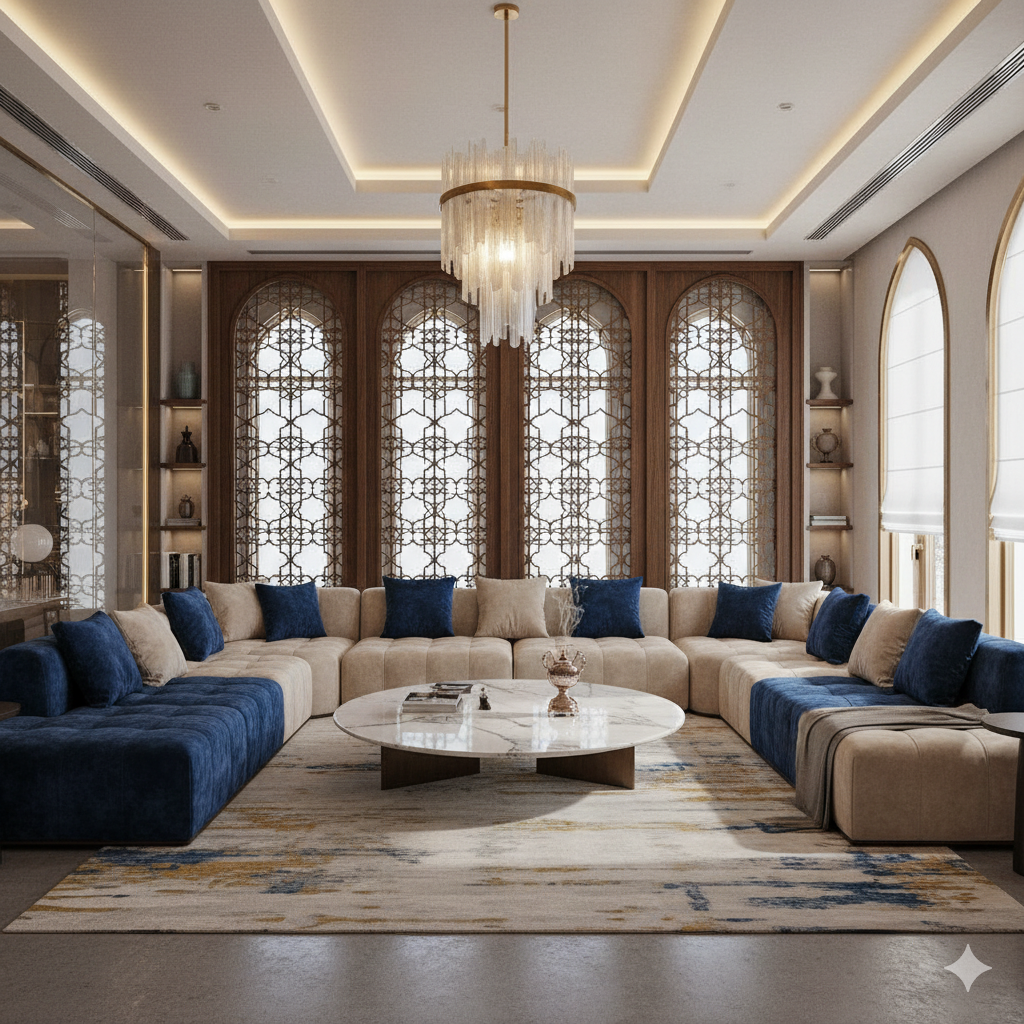
In recent years, an evolution in Majlis design has become apparent, reflecting a desire to honor a rich heritage while embracing a global, contemporary aesthetic. This has given rise to the “Modern Majlis” or “Neoclassical Majlis”.37 This style is characterized by a blend of traditional grandeur with modern sensibilities. It often features cleaner lines, a more minimalist approach to decoration, and a neutral color palette, which then serves as a sophisticated backdrop for select traditional decorative pieces or opulent, classically styled furniture.37 This fusion creates a space that feels both timeless and current, reflecting the cosmopolitan nature of modern Saudi society.
Ultimately, the design of a Majlis is a carefully calibrated performance. It is a delicate balancing act between projecting the host’s status and creating an environment of genuine comfort and welcome. The opulence of the materials, the richness of the colors, and the intricacy of the decoration all serve to honor the guest and signal the host’s significant standing within the community. Simultaneously, the spacious layout, the communal seating arrangement, and the plushness of the textiles are engineered to create a relaxed, inviting atmosphere conducive to the long, unhurried conversations that are the lifeblood of the Majlis. The aesthetic is fundamentally performative, a meticulously designed stage upon which the sacred ritual of hospitality is enacted.
A Synthesis of Cultures
Chapter 5: A Perfect Union: Weaving Italian Elegance into the Majlis Fabric
The convergence of classic Italian furniture and the design of the royal Saudi Majlis represents a perfect aesthetic and functional union. This is not a superficial application of a foreign style, but a deep, resonant alignment of values and purpose. The core characteristics of the great Italian design traditions—grandeur, craftsmanship, and comfort—do not merely decorate the Majlis; they actively enhance its ability to perform its essential cultural functions.
5.1 A Shared Language of Luxury and Power
The Saudi Majlis, particularly at the royal and governmental level, is a space where the host’s status, influence, and prosperity are communicated to guests.36 It is a stage for the performance of power and prestige. In this, it shares a fundamental purpose with the European courts that gave birth to the Baroque style. The grandeur, massive scale, and commanding presence of Italian Baroque furniture, designed specifically to fill vast palace halls and inspire awe, find a natural and fitting home in the spacious architecture of a modern Majlis.3 The dramatic carvings, rich gilding, and imposing forms speak a universal language of authority and magnificence that translates seamlessly into this context.
5.2 Craftsmanship as a Signifier of Respect
A central tenet of Arabian hospitality is to offer the very best to one’s guests as a sign of honor and respect.34 The meticulous, time-honored craftsmanship inherent in classic Italian furniture is a powerful, tangible expression of this value. The use of noble materials like solid wood, fine marble, and gold leaf, combined with the visible evidence of masterful hand-carving, marquetry, and upholstery, sends a clear, non-verbal message to the visitor: you are valued, and nothing has been spared for your comfort and welcome.25 The furniture becomes a testament to the host’s generosity and their commitment to the highest standards of quality.
5.3 Comfort Engineered for Conversation
Beyond its visual splendor, the Majlis is fundamentally a social space, designed for long hours of relaxed conversation, negotiation, and community bonding.33 Italian furniture, particularly from the Rococo and Neoclassical periods, was developed with precisely this kind of social interaction in mind. The emphasis on comfort is paramount.10 The plush, deep upholstery of Italian sofas and armchairs, the ergonomic forms designed for lounging (such as the classic French bergère chair), and the creation of inviting conversational groupings are all ideally suited to the primary function of the Majlis. This focus on luxurious comfort encourages guests to linger, engage in dialogue, and feel completely at ease, thereby facilitating the social cohesion that the Majlis is meant to foster.
The widespread adoption of classic Italian furniture in the design of high-end Majlis spaces should not be misinterpreted as a simple act of Westernization. It is, rather, a highly strategic and sophisticated appropriation of a global language of luxury to better articulate and amplify traditional Arabian values. The core function of the Majlis is to honor guests and build community, which requires an environment that is at once deeply impressive and genuinely comfortable.33 Classic Italian furniture, particularly from the Baroque and Rococo periods, was historically perfected to furnish the grand reception rooms of European elites for precisely these twin purposes: to project status and to facilitate refined social interaction.3 The aesthetic values are directly transferable. The “sense of awe” that the Catholic Church sought to inspire with Baroque design is analogous to the “impeccable taste” and “prosperity” a Saudi host wishes to convey to their guests.4 Therefore, when a Saudi royal or dignitary selects these pieces, they are not importing a foreign culture wholesale. Instead, they are choosing a design vocabulary that has been historically engineered to perform the very functions their Majlis serves. The Italian furniture does not supplant the cultural meaning of the Majlis; it magnifies it, allowing timeless local traditions of hospitality to be expressed on a contemporary global stage.
Chapter 6: Modenese: A Case Study in Royal Appointments
To fully illustrate the synthesis of Italian craftsmanship and Saudi tradition, it is essential to examine a company that embodies this union. Modenese Furniture, with its two-century legacy and a significant portfolio of projects in the Kingdom, serves as the exemplar of a heritage brand perfectly attuned to the unique demands of furnishing the royal Saudi Majlis.
6.1 A Legacy Forged in Wood: Two Centuries of Craft
Modenese’s story begins in 1818 in the village of Casale di Scodosia, Italy, a heartland of traditional furniture making.2 Founded as a small artisan shop, or “Bottega”, the company has remained a family-run enterprise for generations, passing down skills and a commitment to excellence.2 This deep, unbroken history is not merely a marketing narrative; it is the foundation of the company’s identity and the source of its authentic craftsmanship. From its origins producing simple wood items to its current status as a global leader in luxury interiors, Modenese has built its reputation on a foundation of exceptional quality and timeless design.2
6.2 Mastery of the Classic Canon
Modenese has cultivated a profound specialization in the grand European design styles that are most sought after for palatial and governmental projects. Their expertise encompasses the majestic drama of the Baroque, the graceful intimacy of the Rococo (often expressed through Louis XV style), and the ordered elegance of Neoclassicism (Louis XVI style).1 This mastery is evident in their meticulous production process, which remains rooted in traditional, artisanal techniques. The journey of a Modenese piece begins with the careful selection of the finest solid woods, which are then transformed by master artisans through the time-honored practices of hand-carving, the creation of handmade marquetry and inlays, the delicate application of gold leaf, and the expert fitting of high-quality upholstery.2
6.3 A Proven Partner in the Middle East
A crucial factor in Modenese’s success is its deep and long-standing engagement with the Middle Eastern market. Recognizing the region’s appetite for classic luxury, the company established a showroom in Dubai in 2010, providing a physical presence and a direct point of contact for its elite clientele.2 This commitment has resulted in an extensive and impressive portfolio of high-profile projects throughout the region. Modenese has been entrusted with furnishing luxurious private villas, mansions, and royal residences in key cultural and economic centers, including Dubai, Jeddah, Mecca, Riyadh, and Doha.38 This track record demonstrates a proven ability to operate at the highest level of the luxury market and to meet the exacting standards of the region’s most discerning clients.
6.4 Furnishing the Majlis: A Record of Excellence
Most significantly, Modenese’s portfolio includes specific, documented experience in designing and furnishing the culturally sensitive and highly important Majlis space. The company showcases a “Stunning Majlis Interior Design For Villa in Mecca, KSA” and a “Classy Majlis Design for Villa in Riyadh, Saudi Arabia. “.38 An analysis of these projects reveals a sophisticated understanding of the Majlis’s requirements. The Riyadh project, for example, is described as a blend of classical and oriental design elements, utilizing pricey materials like wood, marble, and gilding. The furniture includes many plush sofas with hand-carved decorations, upholstered in silvery silk with blue velvet cushions, and complemented by coffee tables with carved legs and malachite tops. The entire ensemble is designed to create an “opulent and respectable mood” that perfectly captures the hospitality and status of the homeowners.38 This ability to tailor their classic Italian aesthetic to the specific cultural context of the Majlis is paramount. It demonstrates that Modenese is not simply selling products, but providing bespoke solutions for performing the high-stakes art of royal hospitality. This cultural fluency, built on years of regional experience, is what distinguishes them as a trusted partner for such significant projects.
Chapter 7: The Contemporary Landscape and Future Horizons
The demand for classic Italian furniture in Saudi Arabia exists within a dynamic and rapidly growing regional market for luxury goods. Understanding the key economic drivers and consumer trends is essential to appreciating both the current state and the future trajectory of this unique cultural-commercial intersection.
7.1 Market Dynamics: A Region of Growth
The Middle East luxury furniture market is a significant and expanding sector, valued at USD 8.5 billion and poised for continued growth.46 This expansion is fueled by powerful macroeconomic and social factors, including rising disposable incomes, a growing number of high-net-worth individuals (HNWIs), and a strong, culturally ingrained appreciation for luxury consumption.47 Saudi Arabia, along with the UAE and Qatar, is a dominant force in this market. National development initiatives, most notably Saudi Arabia’s Vision 2030, are actively fostering growth in the luxury sector by driving construction, tourism, and economic diversification 47
7.2 Key Trends Shaping Demand
Several key trends are shaping the preferences of elite consumers in the region and influencing the luxury furniture market.
- Customization and Personalization: There is a powerful and growing demand for bespoke furniture solutions. Discerning clients are moving away from off-the-shelf products in favor of unique, personalized pieces that reflect their individual taste and status. Market data indicates that 65% of luxury consumers express a strong interest in customized products.47 This trend plays directly to the strengths of artisanal Italian producers like Modenese, whose entire production model is based on “tailor-made” and bespoke creation.41
- Sustainability and Eco-Consciousness: While still an emerging trend in the region, global shifts towards sustainability are beginning to influence the luxury market. There is a growing interest in eco-friendly materials, responsibly sourced wood, and greater transparency in supply chains.49 Heritage brands that use natural, durable materials and create “heirloom” pieces designed to last for generations are well-positioned to align with this value.
- The Rise of E-commerce and Digitalization: The way luxury goods are discovered and purchased is evolving. The expansion of e-commerce platforms provides new channels to reach affluent consumers, while advanced technologies like AI-driven digital design experiences and virtual or augmented reality shopping are becoming more prevalent.47 Companies are adapting by providing resources like 3D models of their furniture for architects and designers, as Modenese does.2
7.3 The Enduring Appeal of “Made in Italy”
Despite the influence of modern trends, the fundamental appeal of classic Italian furniture in the Saudi market remains firmly rooted in its core attributes. The “Made in Italy” label continues to be a powerful signifier of superior quality, deep cultural heritage, and timeless elegance.25 In a market where the expression of status and the creation of a lasting legacy are paramount, these qualities are non-negotiable. Heritage brands like Modenese, with their verifiable two-century history and unwavering commitment to traditional craft, offer an authenticity that cannot be replicated by mass-luxury brands. They are uniquely positioned to satisfy the deepest desire of the luxury consumer: to own something not just of high value, but of real and enduring meaning.
Looking forward, the future of the luxury Majlis will likely involve a sophisticated synthesis of deep tradition and cutting-edge modernity. It is conceivable that a royal host might use virtual reality to customize the layout of their Modenese furniture, demand sustainably sourced wood for their hand-carved sofas, and integrate state-of-the-art smart home technology into a room where the ancient rituals of coffee service and oral poetry are still practiced. The brands that will thrive in this future landscape will be those that can successfully bridge this gap—honoring a profound heritage while embracing the innovations that define contemporary life.
Chapter 8: Enduring Legacies, Shared Values
This analysis has traced the distinct yet convergent histories of classic Italian furniture and the Saudi Majlis, revealing a relationship built on a foundation of shared values. The grand European design lexicon—from the power of the Baroque to the intimacy of the Rococo and the order of the Neoclassical—provided a rich visual language for expressing status and facilitating social connection. Simultaneously, the Italian peninsula cultivated an unparalleled ecosystem of artisanal craftsmanship, transforming noble materials into objects of enduring beauty and function. In parallel, the Majlis evolved in the Arabian Peninsula as the physical embodiment of a culture’s commitment to hospitality, community, and dialogue—a sacred space whose design is dedicated to the honor of the guest and the reinforcement of social bonds.
The confluence of these two traditions in the modern royal Majlis is a testament to a deep, symbiotic alignment. The core tenets of classic Italian furniture—its commanding presence, its dedication to comfort, and its exquisite, handcrafted quality—serve to amplify the core functions of the Majlis. The grandeur of a Baroque-style console does not merely decorate the space; it articulates the host’s prestige. The plush comfort of a Rococo-inspired sofa does not just offer a place to sit; it engineers an environment for the long, meaningful conversations that build community. The visible mastery of the craftsmanship is not simply an aesthetic detail; it is a tangible gesture of the profound respect afforded to every guest who enters.
Ultimately, the choice to furnish a royal Saudi Majlis with elite Italian furniture is far more than a matter of interior design. It is a sophisticated, 21st-century expression of timeless and deeply held cultural values—generosity, respect, community, and legacy. It demonstrates with striking clarity how globalized luxury, when selected with wisdom and applied with cultural fluency, can serve to celebrate and elevate, rather than erode, profound local traditions. The result is a space that is at once deeply Saudi and universally majestic, a powerful testament to the enduring art of hospitality and the shared human desire to live beautifully.
Works cited
- Modenese Gastone Interiors – Salone del Mobile Milano, accessed October 22, 2025, https://www.salonemilano.it/en/brands/modenese-gastone-interiors
- Luxury Italian Furniture – Modenese Luxury Interiors Since 1818, accessed October 22, 2025, https://www.modenesefurniture.com/about-us
- ALGEDRA BLOG – Baroque Interior Design, accessed October 22, 2025, https://algedra.com.tr/en/blog/baroque-interior-design
- Baroque Style Interior Design: Elements and History – Homedit, accessed October 22, 2025, https://www.homedit.com/interior-design/styles/baroque-style-interior-design/
- Italian Baroque interior design – Wikipedia, accessed October 22, 2025, https://en.wikipedia.org/wiki/Italian_Baroque_interior_design
- Guide: What is Baroque Interior Design – HGTV, accessed October 22, 2025, https://hgtv.co.uk/inspiration/guide-what-is-baroque-interior-design/
- algedra.com.tr, accessed October 22, 2025, https://algedra.com.tr/en/blog/baroque-interior-design#:~:text=Baroque%20interiors%20feature%20luxurious%20materials,sense%20of%20wealth%20and%20grandeur.&text=Ornate%20carvings%20and%20detailed%20moldings,leaves%2C%20scrolls%2C%20and%20cherubs.
- Interior Design History And Origins Explained – Décor Aid by Foter, accessed October 22, 2025, https://foter.com/decoraid/blog/interior-design-history/
- History of Interior Design: How People Started Designing – Spaces by Dee, accessed October 22, 2025, https://www.spacesbydee.com/history-of-interior-design-how-people-started-designing/
- Guide: What is Rococo Interior Design – HGTV, accessed October 22, 2025, https://hgtv.co.uk/inspiration/guide-what-is-rococo-interior-design/
- en.wikipedia.org, accessed October 22, 2025, https://en.wikipedia.org/wiki/Rococo#:~:text=Rococo%20features%20exuberant%20decoration%2C%20with,interiors%20are%20dominated%20by%20ornamentation.
- Rococo – Wikipedia, accessed October 22, 2025, https://en.wikipedia.org/wiki/Rococo
- The Rococo style – an introduction – London – V&A, accessed October 22, 2025, https://www.vam.ac.uk/articles/the-rococo-style-an-introduction
- Blog – Rococo Style: Furniture, Painting and Sculpture Guide …, accessed October 22, 2025, https://www.mayfairgallery.com/blog/rococo-style-furniture-painting-sculpture-guide/
- The Evolution of Luxury Interiors: From Past to Present – DOCA Boston Kitchens, accessed October 22, 2025, https://docabostonkitchens.com/evolution-of-luxury-interiors/
- Neoclassical Interior Design: Everything You Need to Know, accessed October 22, 2025, https://decorious.com/en/blogs/neoclassical-interior-design
- The History and Key Pieces of Neoclassical Interior Design – Styylish, accessed October 22, 2025, https://styylish.com/the-history-and-key-pieces-of-neoclassical-interior-design/
- Neoclassical Interior Design: A Go-To Guide to Get the Look …, accessed October 22, 2025, https://www.decorilla.com/online-decorating/neoclassical-interior-design-style/
- Hallmarks of Neoclassical Interior Design & Architecture, accessed October 22, 2025, https://laurau.com/hallmarks-of-neoclassical-interior-design-architecture/
- Neoclassical Interior Design | Neoclassic Home Decorating Style – Nazmiyal Rugs, accessed October 22, 2025, https://nazmiyalantiquerugs.com/blog/neoclassical-interior-design/
- Evolution of Traditional Italian Furniture | Michelangelo Designs, accessed October 22, 2025, https://www.michelangelodesigns.com/evolution-of-traditional-italian-furniture-design/
- A Brief Overview of The Rich History of Italian Furniture Craftsmanship, accessed October 22, 2025, https://italian-interiors.com/blog/a-brief-overview-of-the-rich-history-of-italian-furniture-craftsmanship/
- All About Tuscany Italian Furniture, accessed October 22, 2025, https://www.davidmichaelfurniture.com/all-about-tuscany-italian-furniture/
- Top 10 Italian Furniture Brands to Know – MATERIA Collection, accessed October 22, 2025, https://materiacollection.com/top-10-italian-furniture-brands-to-know/
- The Art of Italian Furniture Design: Understanding the History and Significance, accessed October 22, 2025, https://modeneseinteriors.com/strong-the-art-of-italian-furniture-design-understanding-the-history-and-significance-strong/
- (PDF) Italian Districts in the Furniture Industry During and After the …, accessed October 22, 2025, https://www.researchgate.net/publication/343672761_Italian_Districts_in_the_Furniture_Industry_During_and_After_the_International_Economic_Crisis
- The Furniture of the Brianza District – Google Arts & Culture, accessed October 22, 2025, https://artsandculture.google.com/story/the-furniture-of-the-brianza-district-unioncamere/WAVhQNXyiwAA8A?hl=en
- The numbers of the supply chain in the wood-furniture regions in Italy – Staff Editoriale, accessed October 22, 2025, https://www.staffedit.it/en/the-numbers-of-the-supply-chain-in-the-wood-furniture-regions-in-italy/
- www.sevensedie.com, accessed October 22, 2025, https://www.sevensedie.com/blog/105/italian-furniture-modern-contemporary-or-classic#:~:text=Wood%2C%20marble%2C%20and%20fine%20fabrics,%2C%20gold%20leaf%2C%20and%20wood.
- The Majlis in the Arabian Peninsula: a social and cultural space – Observatory Patrimoine d’Orient, accessed October 22, 2025, https://patrimoinedorient.org/index.php/en/2020/04/09/the-majlis-in-the-arabian-peninsula-a-social-and-cultural-space/
- ‘Majlis’: Arabic word for sitting room is rooted in the traditions of the Gulf – The National News, accessed October 22, 2025, https://www.thenationalnews.com/arts-culture/2025/08/01/learn-arabic-majlis-sitting-room/
- Majlis – Wikipedia, accessed October 22, 2025, https://en.wikipedia.org/wiki/Majlis
- Majlis, a cultural and social space – UNESCO Intangible Cultural …, accessed October 22, 2025, https://ich.unesco.org/en/RL/majlis-a-cultural-and-social-space-01076
- The Majlis: Preserving Tradition and Building Community in Arabic Culture – Medium, accessed October 22, 2025, https://medium.com/@salmanzia13/the-majlis-preserving-tradition-and-building-community-in-arabic-culture-83d9c2662f40
- Majlis: A confluence of the past, present and future | Arab News, accessed October 22, 2025, https://www.arabnews.com/node/489626/amp
- Majlis Saudi Arabia – Antonovich Group, accessed October 22, 2025, https://antonovich-design.ae/majlis-saudi-arabia.html
- Arabic Majlis Interior Design, accessed October 22, 2025, https://algedra.com.tr/en/residential-interior-design/interior-design-villas/majlis-design
- Luxury classic furniture made in Italy handmade interiors, accessed October 22, 2025, https://modeneseinteriors.com/portfolio-category/projects/
- Majlises Design | Aljudisa, accessed October 22, 2025, https://aljudisa.com/en/majlises-design/
- Majlis Design – Arabic Majlis Interior Design, accessed October 22, 2025, https://www.algedra.com.tr/en/residential-interior-design/interior-design-villas/majlis-design
- Modenese Luxury Interiors: Classic style furniture | Archiproducts, accessed October 22, 2025, https://www.archiproducts.com/en/modenese-luxury-interiors
- History Of Classic Furniture – Via Roma, 92, 35040 Casale di Scodosia PD, Italy – Modenese Luxury Interiors, accessed October 22, 2025, https://trends.archiexpo.com/modenese-luxury-interiors/project-63930-284539.html
- history of classic furniture – luxury interior design, accessed October 22, 2025, https://modeneseinteriors.com/portfolio-items/history-of-classic-furniture/
- trends.archiexpo.com, accessed October 22, 2025, https://trends.archiexpo.com/modenese-luxury-interiors/project-63930-284539.html#:~:text=Since%201818%2C%20Modenese%20Luxury%20Interiors,%2C%20imperial%2C%20and%20rococ%C3%B2%20style.&text=The%20Baroque%20style%20dates%20back%20to%20the%20years%20between%201600%20and%201720.
- The Production Process of Creating Furniture at Modenese Interiors – Architizer, accessed October 22, 2025, https://architizer.com/projects/the-production-process-of-creating-furniture-at-modenese-interiors/
- www.kenresearch.com, accessed October 22, 2025, https://www.kenresearch.com/middle-east-luxury-furniture-boutiques-retail-market#:~:text=The%20Middle%20East%20Luxury%20Furniture%20Boutiques%20Retail%20Market%20is%20valued,home%20aesthetics%20and%20interior%20design.
- Middle East Luxury Furniture Market | 2019 – 2030 | Ken Research, accessed October 22, 2025, https://www.kenresearch.com/middle-east-luxury-furniture-boutiques-retail-market
- Furniture Market Analysis – Middle East | Forecast 2033 – IMARC Group, accessed October 22, 2025, https://www.imarcgroup.com/middle-east-furniture-market
- Luxury Furniture Market Size, Share & Growth Analysis, 2032, accessed October 22, 2025, https://www.gminsights.com/industry-analysis/luxury-furniture-market
- Luxury Furniture Market Report 2025 – Research and Markets, accessed October 22, 2025, https://www.researchandmarkets.com/reports/5895269/luxury-furniture-market-report
- Luxury Furniture Market Size and Share Report|Forecast 2034, accessed October 22, 2025, https://www.thebusinessresearchcompany.com/report/luxury-furniture-global-market-report
- Modenese Luxury Furniture, accessed October 22, 2025, https://www.modenesefurniture.com/